Best Random Objects Generator for Students, Teachers, and Classrooms
Every educator knows the struggle of keeping students continuously engaged throughout the school day. Whether you are building morning meeting routines or introducing an advanced high school English writing unit, breaking through academic fatigue can be a monumental challenge. If standard worksheets feel repetitive and typical flashcards fail to spark participation, digital tools offer a dynamic alternative.
By utilizing an online Random Objects generator, you unlock an unlimited supply of unexpected prompts, tangible item definitions, and creative sparks. A single click can reveal anything from an antique compass or a microscope slide to a magnifying glass or a wooden spatula. These items provide an instant framework for interactive learning.
Tools like the Random Object Generator or Randoms Object Generator allow teachers and students to effortlessly pull up diverse sets of items. Let’s explore how a dedicated platform for Random Objects can revitalize your lesson plans, streamline classroom management, and spark creative thinking.
Why Use a Random Objects Generator in Education?
Introducing Random Objects into your educational architecture is not just about playing games; it serves as a powerful pedagogical tool that sharpens cognitive skills. When students are forced to analyze unexpected items, they engage in secondary elaboration and lateral thinking.
Overcoming Writer’s Block
When given an open-ended essay prompt like “Write a creative narrative,” students often stare at a blank page. By using a tool that generates Random Objects, you give them a concrete anchor point. Starting a narrative with a rusty key or a broken pocket watch gives the mind a structural puzzle to solve.
Enhancing Vocabulary Acquisition
For elementary students or English as a Second Language (ESL) learners, concrete nouns are the building blocks of language proficiency. Introducing fresh Random Objects ensures that students expand their vocabulary beyond standard textbook terms. It forces them to look up definitions, practice correct spelling, and identify precise synonyms.
Step-by-Step Guide: Implementing Random Objects in Your Next Lesson Plan
Integrating an online tool into your daily curriculum requires minimal preparation. Follow this straightforward execution framework to ensure a fluid classroom experience:
Implementation Protocol
1
Select and Launch the Generator
Prep Phase
1.Select and Launch the Generator:Prep Phase.
Open a clean browser tab featuring an established tool like Random Object Generator or Randoms Object Generator on your classroom interactive whiteboard or projector screen.
2
Set the Academic Parameters
Context Phase
2.Set the Academic Parameters:Context Phase.
Clearly explain the learning objective to your students before clicking the button. Specify whether the upcoming item will be used for a descriptive vocabulary sentence, a creative writing prompt, or a scientific classification drill.
3
Generate the Live Target Items
Execution Phase
3.Generate the Live Target Items:Execution Phase.
Trigger the generator mechanism to display your Random Objects. If you are managing a large group or running an advanced workshop, adjust the counter parameters to generate multiple unique items simultaneously.
4
Facilitate Student Reflection
Assessment Phase
4.Facilitate Student Reflection:Assessment Phase.
Give your students a fixed, timed window (e.g., 2 to 5 minutes) to complete their assigned verbal response, written paragraph, or scientific analysis based on the displayed items.
15 High-Impact Classroom Activities Using Random Objects
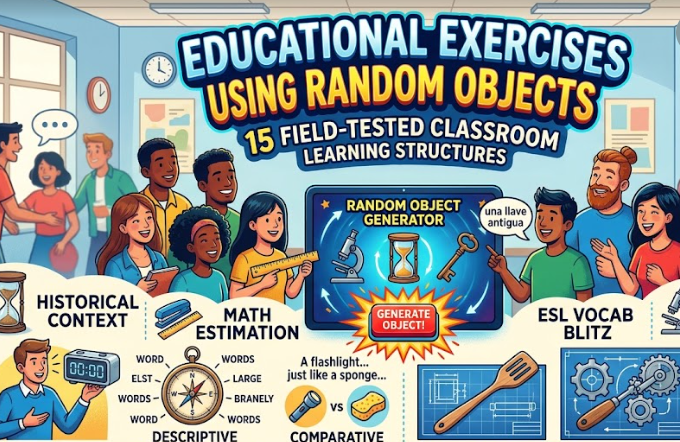
To help you get started right away, here are 15 highly effective, field-tested educational games and learning structures centered around an online Random Objects pipeline.
1. The Three-Item Story Catalyst
Subject Focus: Creative Writing & ELA
How it works: Instruct the system to show three distinct Random Objects simultaneously on your screen. Students must compose a short story paragraph where characters interact naturally with all three items. This forces them to build imaginative plot connections between completely unrelated things.
2. Descriptive Adjective Matrix
Subject Focus: Grammar & Vocabulary Building
How it works: Generate a single item. Students have 60 seconds to write down as many vivid adjectives as possible that describe its physical attributes (texture, shape, durability, weight, and materials). This expands their descriptive writing toolkit.
3. The Science Material Breakdown
Subject Focus: Physics, Chemistry, & General Science
How it works: Pull up an item via the generator. Students must analyze its real-world composition. Ask them to identify whether the item is primarily made of polymers, metals, ceramics, or organic compounds, and discuss the mechanical properties of those materials.
4. Historical Context Placement
Subject Focus: Social Studies & World History
How it works: Generate a random item like an hourglass or a fountain pen. Ask students to travel backward along a historical timeline to explain when this item was invented, how it impacted society, and what modern technology eventually replaced it.
5. The ESL Functional Identification Challenge
Subject Focus: Language Acquisition & Speech
How it works: Perfect for language learners. Generate an item, and have the student explain its utility using complete sentences. For example, if the tool presents a colander, the student must state: “This is a kitchen tool, and we use it to drain water from pasta.”
6. Mathematical Dimension Guessing
Subject Focus: Measurement, Ratios, & Geometry
How it works: Display an item on screen. Students must estimate its real-world physical attributes using metric units (length in centimeters, mass in grams, or volume in milliliters). Reveal the true average dimensions afterwards to practice estimation accuracy.
7. The Entrepreneurial Pitch
Subject Focus: Public Speaking & Business Studies
How it works: Generate an everyday household object. Students are grouped into pairs and given two minutes to brainstorm an entirely new commercial market for it. They must present a fast-paced sales pitch to the class explaining why this item is essential.
8. The Blueprint Designer
Subject Focus: STEM & Engineering
How it works: Pull a random prompt from your list of Random Objects. Students must sketch a basic engineering schematic showing how that object could be modified or integrated into a larger mechanical system to solve a common household problem.
9. Comparative Analogy Training
Subject Focus: Logic & Metaphorical Analysis
How it works: Generate two completely different Random Objects (e.g., a flashlight and a sponge). Students must construct a logical analogy sentence connecting them, such as: “A flashlight sheds light on dark spaces, just like a sponge absorbs spilled liquid to clean a surface.”
10. The Foreign Language Blitz
Subject Focus: Spanish, French, or German Class
How it works: Spin the generator to reveal an item. The first student to successfully translate that object’s name into their target foreign language—complete with the correct gendered article—earns a point for their team.
11. Artistic Silhouette Drawing
Subject Focus: Visual Arts & Creative Design
How it works: Generate an object with a complex physical shape (like an intricate key or an antique lantern). Students are given a quick two-minute window to sketch its geometric outline, practicing spatial proportions and structural symmetry.
12. The Cause and Effect Sequence
Subject Focus: Critical Thinking
How it works: Generate an item. Ask your students to predict a catastrophic event or a funny scenario that would happen if that item suddenly ceased to exist globally overnight. This exercises their long-term predictive reasoning skills.
13. Socratic Object Interrogation
Subject Focus: Philosophy & Debate
How it works: Select an object from the list. Challenge your classroom with abstract philosophical questions regarding it: “Who owns the rights to this design? Is this item a luxury or a basic human necessity? How does it affect global sustainability?”
14. The Class Memory Grid
Subject Focus: Cognitive Retention & Focus
How it works: Generate 5 separate items in a row, showing each to the class for three seconds before clearing the screen. Students must rely on their visual short-term memory to write down the exact list in the correct order.
15. The Hybrid Invention Challenge
Subject Focus: Industrial Design & Creative STEM
How it works: Generate two random consumer items on screen. Students must merge the functionalities of both items to design a single, innovative hybrid invention, explaining exactly how it functions.
Frequently Asked Questions (FAQs)
What is an online Random Objects generator?
An online randomizer tool is a specialized database application designed to instantly display the names, properties, or images of unexpected items from a deep digital catalog of everyday consumer products, household goods, tools, foods, and historical artifacts.
Are these generator tools completely safe for school-aged kids?
Yes. Dedicated websites like Random Object Generator focus entirely on clean, curated databases containing family-friendly objects, educational supplies, and natural artifacts, making them highly appropriate for classrooms, elementary education, and online virtual meetings.
Can I generate multiple items simultaneously for large group projects?
Absolutely. Both Random Object Generator and Randoms Object Generator allow users to customize their configurations. You can adjust the parameters to display multiple distinct items at once, which is perfect for complex team assignments or multi-stage creative projects.
Do teachers need to purchase software to use these tools?
No. The digital randomizers mentioned throughout this article are completely free, open-access web utilities. They operate natively within any standard mobile or desktop web browser without requiring user registration, installations, or paywalls.